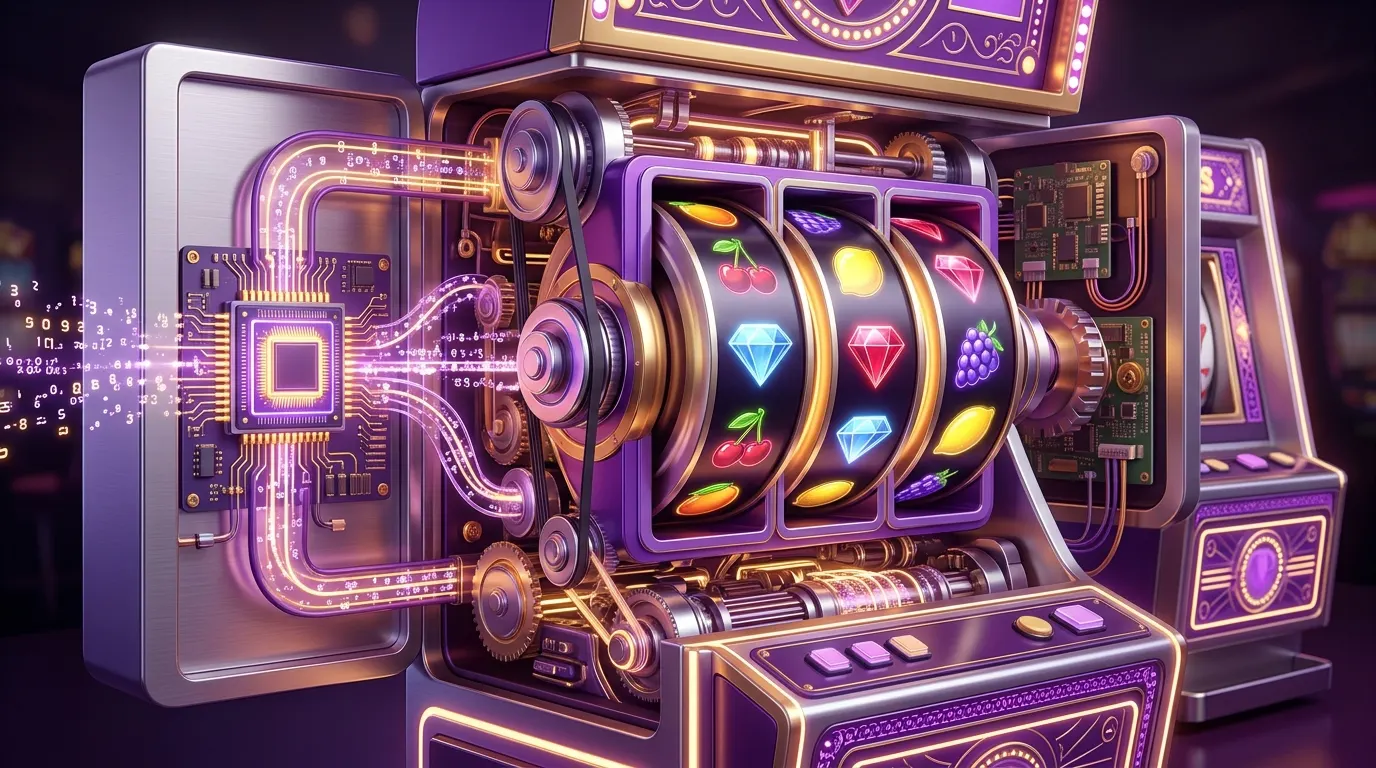
How do pokies work? Under the flashing lights and the coin-drop sounds, every pokie in an Aussie pub or club is a computer running one job: picking a random result each time you press the button. The reels you see are just a picture of a decision that has already been made.
This guide walks through that maths in plain English: the random number generator, how much a machine pays back, what volatility means, lines versus ways, how features work and why a near-miss feels so close. We also answer the question everyone types into Google, how to win on pokies, as honestly as we can.
How do pokies work? The random number generator decides
Every modern pokie has a random number generator, or RNG. It is a piece of software that churns out numbers constantly, thousands of times a second, even when nobody is playing. The moment you press Spin, the machine grabs the current number and uses it to decide where each reel stops.
Everything after that is theatre. The spinning reels, the slow stop on reel five, the music that builds when two scatters land: the result was locked in the instant you pressed the button. Victoria's gambling regulator puts it simply: every spin is random and independent, and previous results don't affect future outcomes.
That independence matters more than anything else on this page. The machine has no memory. It does not know you have fed it for an hour, it does not know the bloke before you just walked off after a long dry spell, and it is never "due" to pay.
Return to player: set by the venue within state limits
Return to player, or RTP, is the share of all money bet that a machine is designed to pay back as prizes over its whole working life. Whatever is not paid back is the venue's cut.
In Australia the percentage is chosen by the venue from options the game offers, within a minimum set by each state or territory. For example, the NSW Gaming Machines Regulation 2019 requires pub and club machines to return not less than 85% of money paid in, and Business Queensland's training material says machines there must return between 85% and 92% over their lifetime. Other states have their own rules, and you generally can't tell from the outside which setting a particular machine is on.
The key word is lifetime. Queensland's material describes that lifetime as roughly three to four years and around a million spins. Over a single session, which might be a few hundred spins, the return you experience can be anything from zero to a lot more than you put in. RTP tells you about the machine's long run, not about your next twenty minutes.
Volatility: how bumpy the ride is
Two pokies can have the same long-run return and feel completely different to play. That difference is volatility, sometimes called variance.
- Lower volatility games pay small wins often. Your credit meter drifts down slowly with plenty of little top-ups along the way.
- Higher volatility games hold back more of their return for bigger, rarer hits, such as a feature with high multipliers or a jackpot. You get longer quiet stretches in between.
Manufacturers rarely print a volatility rating on the glass, so any rating you read (including ours on game pages) is an informed opinion based on how the game is built. Big multipliers, linked jackpots and features that are hard to trigger usually point to a bumpier ride.
Paylines versus ways to win
Older pokies, such as the original Queen of the Nile, pay on lines. A line is a fixed path across the reels, and you only win when matching symbols sit on a line you have paid for, starting from the left.
Aristocrat changed the game with ways. On a 5-reel, 3-row screen, any matching symbol on each consecutive reel from the left counts, whatever row it is in. Three positions on each of five reels gives 3 × 3 × 3 × 3 × 3 = 243 ways. Aristocrat calls this Reel Power, and the bigger 4-row version gives 1,024 ways. Our Reel Power guide has a worked example.
More ways does not mean better value. The pay table is built around the number of ways, so a 1,024-ways game simply pays smaller amounts per combination than you might expect. It is a different shape of game, not a more generous one.
Features, jackpots and links
The "feature" is what most punters are chasing. It is a bonus round triggered by a set combination, usually three or more scatter symbols. Common types include:
- Free games, often with multipliers or extra wilds, like the classic tripled wins in Queen of the Nile.
- Hold & Spin, where special symbols lock in place for respins. It made its name in Lightning Link and is explained in our Hold & Spin guide.
- Jackpots, either standalone (one machine) or linked across a bank of machines, which is why the meter above a bank keeps ticking up.
Features are decided by the same RNG as every other spin. A machine that hasn't given a feature in a while is not closer to one. The odds on each spin are the same as the spin before.
Why near-misses feel so close
Two scatters land and the third sails just past. It feels like you nearly had it. You didn't. A near-miss is just a loss that happens to look like a win.
Researchers have studied this for decades. A 2009 brain-imaging study by Luke Clark and colleagues found that near-misses lit up the same reward areas as real wins and made people keener to keep playing, even though the outcome was a loss. Victoria's regulator is blunt about it: near-misses or almost wins don't mean a win is coming.
Reels can also be built so that some symbols appear more often on certain reels than others, which is one reason two scatters can feel common and the third rare. The picture on screen is not a fair guide to the odds underneath.
How to win on pokies: the honest answer
You can't beat the RNG. There is no button timing, no lucky stool, no pattern and no time of day that changes the result. Queensland's responsible gambling training lists these exact beliefs (touching the buttons a certain way, playing at certain times, being "owed" after losses, lucky items) as myths. Over time the machine is built to keep a share of what goes in.
What you can control is everything around the spin:
- Budget. Decide what a night of entertainment is worth before you sit down, and treat it as spent.
- Bet size. Smaller bets stretch the same budget over more spins. Max bet doesn't change the odds on most games, it just changes how fast you go.
- Time. Set a finish time and stick to it. Pokies are fast, and an hour can disappear.
- Game choice. Pick games whose volatility suits your mood, and learn the features for free first in an official app, as covered on our free Aristocrat pokies page.
Our Aristocrat pokies tips page goes into more detail. And if it ever stops being fun, have a read of our play-safely page.